Analytical Modeling
Customer Segmentation
Customer behavior analysis workflow that prepares transaction data, builds unsupervised segments, visualizes structure, and evaluates cluster quality.
Overview
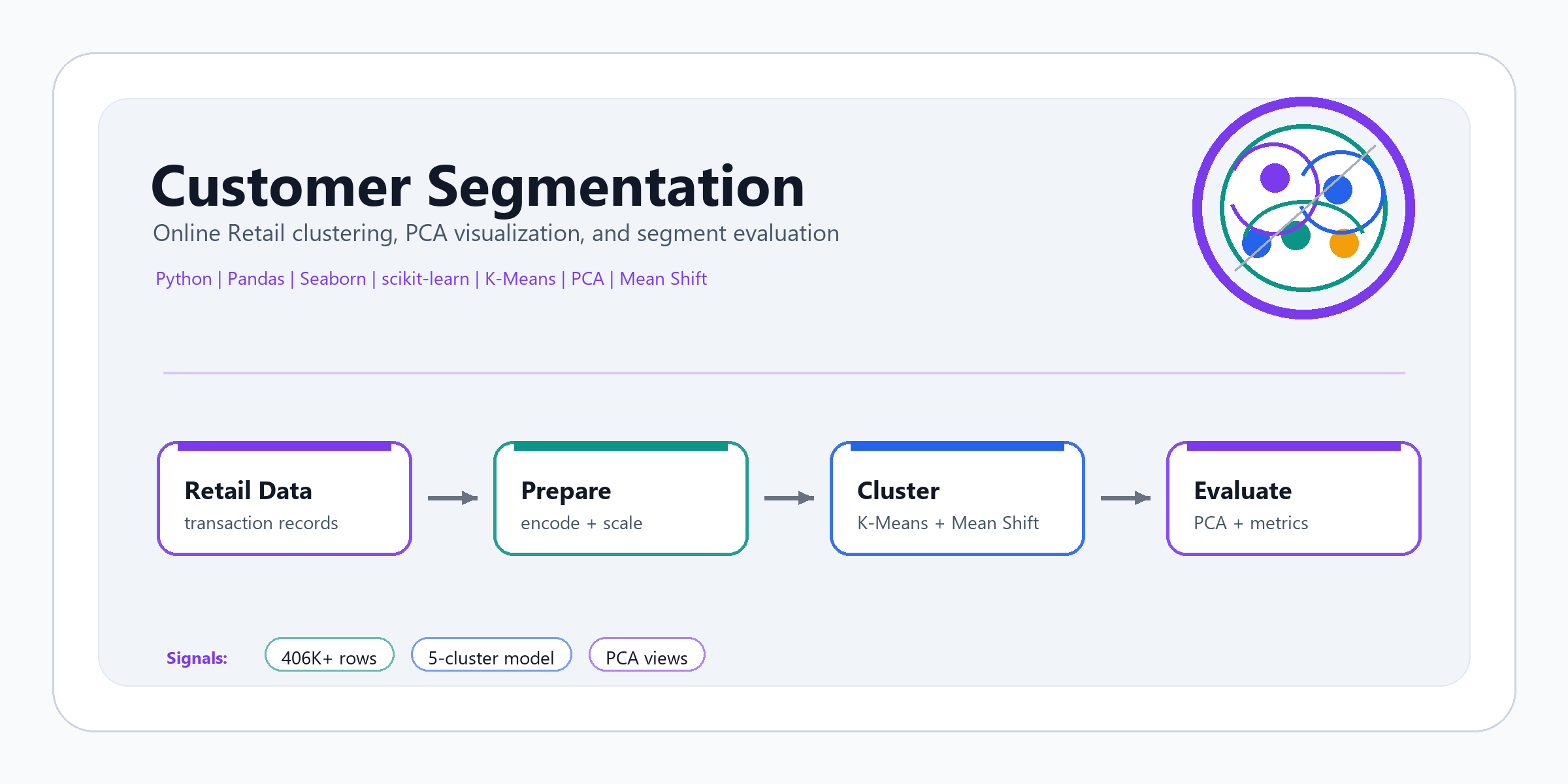
Customer Segmentation is a notebook-based analytical modeling project that groups Online Retail customers into behavioral segments. The workflow covers data loading, cleaning, categorical encoding, normalization, exploratory analysis, clustering, dimensionality reduction, and evaluation.
Problem
Organizations often have transaction-level data but no predefined labels for customer types. Clustering helps discover natural structure in purchasing behavior and supports marketing strategy, retention analysis, and customer profiling.
Solution
The notebook prepares the retail transaction dataset by removing missing and invalid rows, encoding categorical fields, scaling features, and evaluating clustering algorithms. K-Means is tested across several cluster counts, while PCA and Mean Shift provide additional structure and comparison.
Technical Highlights
- Data cleaning for missing values and invalid negative quantities.
- Categorical encoding with
LabelEncoder. - Feature scaling with
MinMaxScaler. - Exploratory analysis with histograms, pair plots, and correlation heatmaps.
- K-Means evaluation across multiple
kvalues. - Cluster metrics including Silhouette, Calinski-Harabasz, Davies-Bouldin, and WCSS.
- PCA visualization for 2D and 3D inspection.
Future Improvements
- Engineer stronger business features such as recency, frequency, monetary value, average basket size, and return rate.
- Export descriptive cluster profiles with business-friendly segment names.
- Convert the notebook into a reproducible Python pipeline.
- Build an interactive dashboard for exploring segment behavior.